
Learn how to start investing with $100. Discover beginner-friendly investment options, smart strategies, and tips to build long-term wealth.
Many people put off investing because they think they need thousands of dollars to get started. In reality, that’s no longer true. Thanks to modern brokerage platforms and fractional investing, you can begin building wealth with as little as $100.
This guide explains how to invest your first $100, where to put it, and how to build a strong foundation for your financial future.
Why Starting Small Is Better Than Waiting
One of the biggest mistakes beginners make is waiting until they have “enough money” to invest. The problem is that there will always be another expense, bill, or reason to delay.
Table of Contents
Starting with $100 allows you to:
- Learn how investing works without taking significant risks
- Build confidence as an investor
- Develop consistent investing habits
- Benefit from long-term market growth
- Take advantage of compound returns
Even a small investment today can be worth much more in the future if you continue contributing regularly.
Understand Your Financial Situation First
Before investing your first $100, make sure your finances are reasonably stable.
Ask yourself these questions:
- Do I have money set aside for emergencies?
- Am I able to pay my monthly bills on time?
- Do I have high-interest debt that should be addressed first?
If you’re carrying expensive credit card debt, paying that down may provide a better return than investing. However, if your finances are under control, investing can be a smart next step.
Set a Clear Investment Goal
Knowing why you’re investing helps you make better decisions.
Your goal might be:
Building Long-Term Wealth
Many people invest simply to grow their money over time and improve their financial security.
Saving for Retirement
Retirement may seem far away, but investing early can make a huge difference because of compound growth.
Reaching a Major Financial Goal
You may be investing for a future home purchase, education expenses, or financial independence.
Whatever your goal, having a purpose helps you stay focused during market ups and downs.
Open an Investment Account
The next step is choosing a brokerage account.
Most online brokers allow users to:
- Open accounts online
- Start with little or no minimum deposit
- Buy fractional shares
- Invest automatically
When choosing a broker, look for:
- Low fees
- Easy-to-use platform
- Access to ETFs and index funds
- Educational resources for beginners
A simple brokerage account is often enough for someone investing their first $100.
Where Should You Invest $100?
Many beginners feel overwhelmed by the number of investment options available. Fortunately, you don’t need a complicated strategy.
Broad Market ETFs
An ETF, or Exchange-Traded Fund, is a collection of many different stocks bundled together.
Instead of betting on one company, you gain exposure to dozens or even hundreds of businesses.
Benefits include:
- Instant diversification
- Lower risk compared to individual stocks
- Lower fees
- Easy management
For many beginners, broad market ETFs are among the simplest investment choices.
Index Funds
Index funds are designed to follow the performance of a market index.
Rather than trying to beat the market, they aim to match it.
Advantages include:
- Diversification
- Long-term growth potential
- Passive investing approach
- Low management costs
Many experienced investors build their portfolios around index funds because of their simplicity.
Fractional Shares
Some popular stocks can be expensive, but fractional shares solve that problem.
Instead of buying a full share, you can purchase a small portion of one.
For example, if a stock costs $500 per share, you can still invest $20, $50, or $100 in that company.
Fractional investing makes it possible to participate in the stock market regardless of budget.
A Sample $100 Investment Strategy
If you’re unsure where to start, keep things simple.
Example:
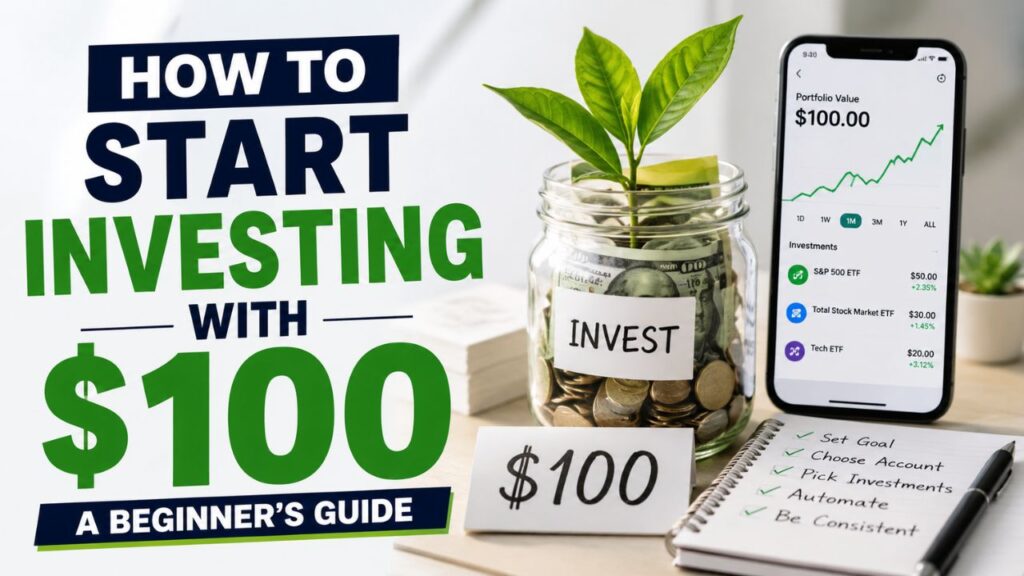
- $80 in a diversified ETF
- $20 in a company or sector you’re interested in
This approach provides diversification while allowing you to learn about individual investments.
Another option is placing the entire $100 into a broad-market ETF and continuing to add money over time.
The Real Secret: Invest Consistently
Your first $100 is only the beginning.
Successful investors focus less on making one perfect investment and more on investing consistently.
Consider setting up automatic contributions such as:
- $10 per week
- $25 every two weeks
- $50 per month
Small contributions can add up significantly over the years.
Consistency often matters more than trying to predict market movements.
The Power of Compound Growth
Compound growth occurs when your investment earnings begin generating additional earnings.
Imagine two people:
Person A invests $100 and never adds more money.
Person B invests $100 and adds $100 each month.
After several years, Person B’s account grows dramatically because each new contribution has time to earn returns.
Compounding rewards patience, which is why many financial experts encourage investing as early as possible.
Common Beginner Mistakes to Avoid
Trying to Get Rich Quickly
The stock market is not a lottery ticket. Building wealth typically takes years, not weeks.
Following Social Media Hype
Many viral investment trends disappear as quickly as they appear. Make decisions based on research rather than excitement.
Putting All Your Money Into One Stock
Concentrating your investment in a single company increases risk.
Diversification can help protect your portfolio.
Selling During Market Declines
Market fluctuations are normal.
Many investors hurt their long-term returns by selling when prices temporarily fall.
Ignoring Fees
Investment fees may seem small, but they can reduce returns over time.
Always understand the costs associated with your investments.
What Happens After Your First $100?
Once you’ve invested your first $100, focus on learning and consistency.
You can continue improving by:
- Reading personal finance books
- Following reputable financial news sources
- Increasing contributions when income grows
- Reviewing your investments periodically
- Staying committed to long-term goals
Investing is a journey rather than a one-time event.
Final Thoughts
Starting with $100 may seem insignificant, but every successful investor begins somewhere. The amount you invest today matters less than the habit you create. By choosing diversified investments, contributing regularly, and focusing on long-term growth, you can turn a small beginning into a meaningful financial future.
The goal isn’t to become rich overnight. The goal is to build a system that allows your money to work for you year after year. Your first $100 can be the first step toward that future.
🔔 Connect With Us
Stay updated with the latest Update,
👉 Join us on WhatsApp – Link
👉 Join our Telegram Channel – Link
👉 Follow us on X (Twitter) – Link
👉 Follow us on Instagram – Link
👉 Like our Facebook Page – Link
👉 Follow us on Threads – Link
Frequently Asked Questions
1. Is $100 enough to start investing?
Yes. Many investment platforms allow investors to start with much less than $100.
2. Should beginners buy stocks or ETFs?
ETFs are generally considered more beginner-friendly because they offer diversification and lower risk than individual stocks.
3. Can I lose money investing?
Yes. Investments can rise and fall in value. However, long-term diversified investing has historically reduced risk compared to short-term speculation.
4. How often should I invest?
Many investors prefer automatic monthly contributions because they create consistency and remove emotional decision-making.
5. What is the biggest investing mistake beginners make?
Waiting too long to start. Time is one of the most powerful factors in successful investing.